


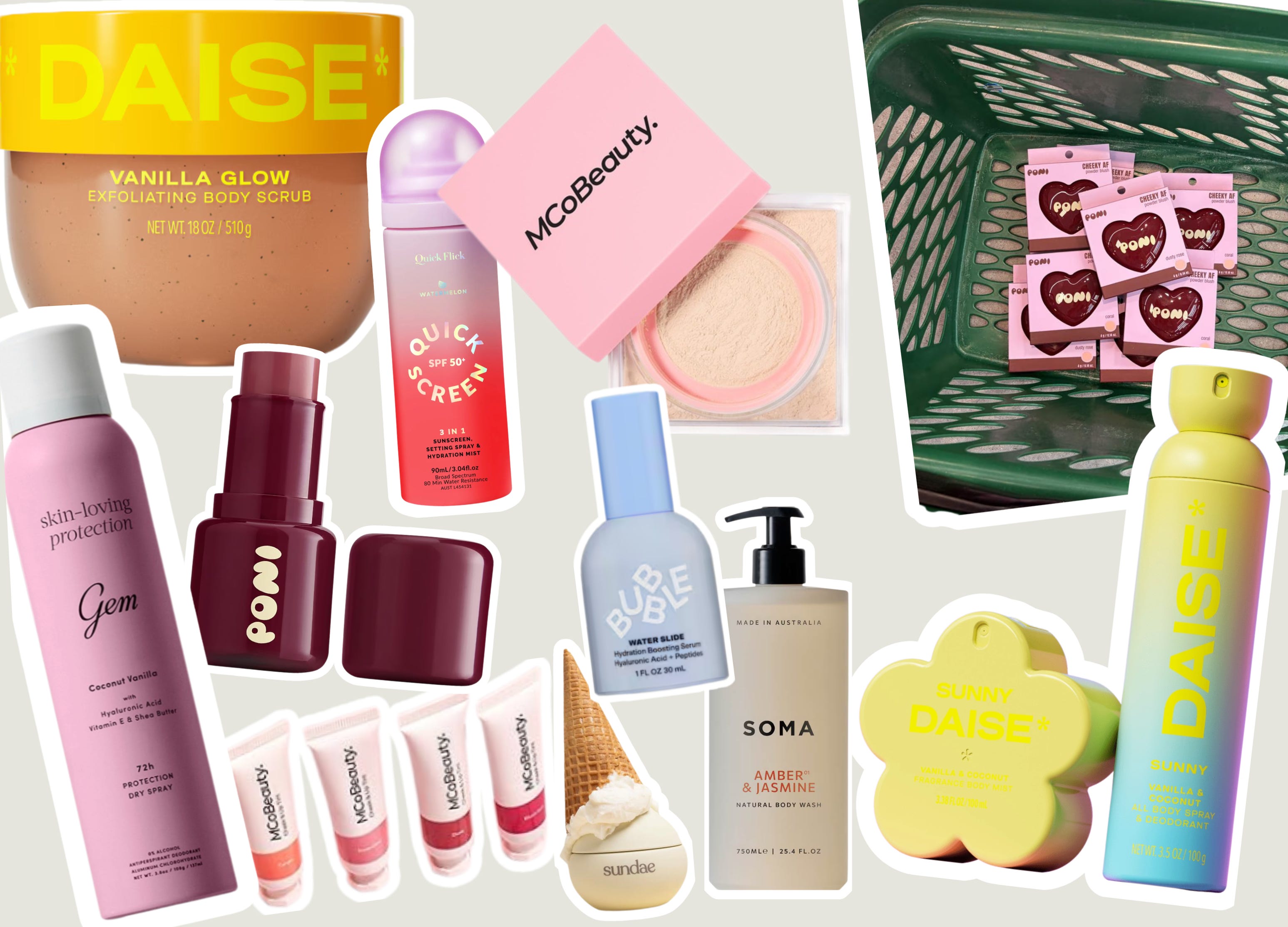
For a very long time, supermarket beauty occupied a very specific place in the Australian psyche.
It was where you bought the things you forgot. Dry shampoo. Cotton pads. An emergency mascara. A cleanser you threw into the trolley because you were already there and still needed to buy yoghurt, bin liners and dinner ingredients. It was practical, but definitely not aspirational. Functional, not thrilling. If specialty beauty retail was built around discovery, desire and atmosphere, supermarket beauty was built around convenience, fluorescent lighting, and hair dye boxes gathering dust.
But the experience of bygone years is well and truly behind us.
Because something more interesting is happening now in Australia. Coles and Woolworths are not simply stocking more beauty brands. They are reshaping what accessible beauty retail looks like, feels like and means for us as consumers. And in doing so, they are forcing a rethink of one of the category’s oldest assumptions, that is - prestige owns desirability, while mass owns scale.
This is not about Coles and Woolies trying to become the next MECCA. It is not about reproducing a Sephora experience. It is not about building prestige beauty cathedrals inside grocery stores. It is something both simpler and smarter. It’s taking the logic of masstige beauty…trend relevance, elevated packaging, social media fluency, strong price architecture and broad appeal…and attaching it to the most habitual retail behaviour in the country. The weekly grocery shop. That is what makes it such a powerful move.
A supermarket does not have to convince people to visit. The foot traffic already exists. The shopping mission is already underway. Beauty is simply inserted into an existing behaviour, not built around a separate one. A customer comes in for milk, toilet paper and wraps and leaves with a peptide hair mask, a skin-loving body wash or a lip oil she has already seen talked about three times on TikTok that week. The distance between routine and indulgence has collapsed. And that matters, particularly in this economy.
Because when consumers feel squeezed, beauty rarely disappears altogether. It gets rerouted. People still want the small hit of pleasure. The little upgrade. The bathroom-shelf refresh. The product that makes an ordinary Tuesday feel just slightly more polished. But they become more selective about what they are willing to pay for it. Supermarkets understand that instinct extremely well.
They are not offering luxury. They are offering enough aspiration, enough trend relevance and enough aesthetic credibility to make beauty feel exciting again, without requiring a separate trip, a higher spend or the psychological overhead of “going beauty shopping.” That is a very compelling proposition for a huge proportion of the market.
And it reveals something the traditional beauty establishment has perhaps been slow to admit…a lot of people do not want a full beauty retail experience every time they buy beauty.
They want speed. Proximity. Value. Familiarity. They want a product that looks good, performs well and can be picked up between the avocados and the dishwasher tablets. For that customer, the supermarket is not a compromise. It is the ideal format and this is why the shift matters.
Because what Coles and Woolworths are building is not a poor man’s version of Sephora. It is a different beauty logic altogether, one grounded in frequency, ease and accessibility, but dressed in the codes of aspiration.
For years, one of the great assumptions in beauty was that desirability had to be protected through separation. Separate stores. Separate language. Separate price points. Separate rituals. The more distinct the channel, the more elevated the product could feel. Supermarkets, by contrast, were treated as the place where brands lost their edge. Where they became ordinary. Where they went to scale, perhaps, but not to build any form of cultural heat. But now? That sentiment looks increasingly outdated.
The brands winning in supermarkets today do not look like the old supermarket brands. They are not dull. They are not daggy. They are not visually anonymous. They are highly coded for the current beauty consumer. Clean branding, trend-literate claims, instantly legible product concepts, packaging that performs well on a shelf and on a screen. They are cheap enough to feel accessible, but not cheap-looking enough to feel disposable and that difference is everything.
What the Australian supermarket giants appear to understand is that accessible beauty only works if it still participates in the language of desire. Nobody wants a bargain that feels dead on arrival. But a product that feels current, attractive and socially validated while still coming in under an easy price threshold? That has enormous power. That is masstige at its most effective.
Not “premium beauty for everyone” in the abstract, but a very specific retail offer -products that feel elevated enough to satisfy aspiration, while remaining casual enough to belong in the weekly shop. And Australian consumers are proving there is appetite for exactly that.
The rise of brands built for accessible distribution tells the story clearly. These are not businesses reluctantly accepting supermarket placement after failing to secure a more glamorous route to market. Increasingly, they are choosing reach, repeatability and mass visibility on purpose. They understand that if your product is priced right, branded right and distributed widely enough, accessibility stops being a compromise and starts becoming the power play.
There was a time when founders often treated premium distribution as the obvious marker of success. Prestige retail gave a brand symbolic value (and stroked the founders ego). It signalled taste, curation and category approval. But the new generation of mass-leaning beauty brands has recognised that symbolic value does not always convert into the strongest business. Reach does. Repeat purchase does. Shelf velocity does. Familiarity does. National visibility does. Being ranged by a supermarket can put a brand in front of an astonishing number of customers, and at astonishing speed.
That kind of scale changes the equation. It means a brand does not need to wait years to slowly build geographic distribution or rely solely on paid acquisition and direct-to-consumer traffic to drive awareness. The supermarket becomes media. Shelf presence becomes brand communication. The aisle becomes an acquisition channel. And once that is understood, supermarket distribution starts to look less like dilution and more like dominance.
This is especially true in a country like Australia, where retail concentration matters. To be present in Coles or Woolworths is not simply to be stocked. It is to become visible in the rhythms of ordinary life. It is to move from “beauty brand” to “household recognition.” It is to show up not just in shopping carts, but in memory.
It is also why the arrival of beauty brands into supermarkets is now increasingly treated as a proper launch moment, not a quiet ranging announcement. This is one of the most fascinating parts of the category’s evolution. Supermarket beauty has developed its own hype machine.
What was once the domain of prestige retail - events, seeding, social chatter, influencer gifting, creator reviews, breathless sell-out headlines - now surrounds accessible launches too. Brands landing in Coles and Woolworths are not being framed as though they have entered a low-status channel. They are being rolled out as if they have arrived somewhere culturally significant…and in a way, they have.
Because the supermarket beauty aisle is becoming a place where beauty “drops” happen. Where consumers discover what is new. Where accessible products generate urgency, social proof and conversation. Where the line between mass retail and beauty culture blurs.
It also tells us something important about how retail status works now. Status no longer belongs only to the exclusive. It can also belong to the highly visible, the culturally fluent and the widely desired. In the age of TikTok, a product does not need to sit behind a prestige counter to feel exciting. It needs to feel validated, well-timed and socially alive.
So the real question is not whether Coles and Woolworths are trying to become MECCA or Sephora. They are not, at least not literally. They are not trying to recreate the prestige beauty experience in full. They are not trying to own luxury skincare, niche fragrance or the high-touch discovery ritual that specialty beauty does so well. They are not building authority through deep curation or service-led immersion.
But that does not mean they are not competing. They are absolutely competing for the beauty wallet. Just not the entire thing.
What they are competing for is perhaps even more commercially important - the frequent, replenishable, lower-friction spend that happens between the glamour moments. The body wash. The haircare. The lip treatment. The impulse cosmetic. The “I may as well grab this while I’m here” purchase. The beauty spend that is habitual rather than ceremonial. And if enough of that spend shifts into the supermarket basket, the consequences for the wider beauty market are meaningful.
Because Coles and Woolworths do not need to replace MECCA to disrupt it. They only need to intercept enough routine spend to reshape what consumers view as necessary, premium or worth a separate trip. They only need to become the default for enough categories, enough use cases and enough households. That is the strategic threat. Not that prestige disappears, but that specialty loses exclusivity over relevance.
In an era defined by cost-of-living pressure, convenience culture and algorithmic product discovery, supermarkets are exceptionally well positioned for this. They can offer immediacy. They can offer visibility. They can offer price accessibility. And increasingly, they can offer products that do not feel like a downgrade.
Because the future of supermarket beauty will not be built on affordability alone. It will be built on brands that understand how to compress aspiration into an accessible format. Brands that feel culturally current. Brands that are easy to understand at a glance. Brands that can sit comfortably in a grocery trolley and still earn a place on a bathroom shelf, in a TikTok haul or in a group chat recommendation.
This is where the category is heading. More exclusive retail launches. More brands built supermarket-first rather than prestige-first. More products designed around the sweet spot between desirability and ease. More segmentation by life stage and use case: teen skincare, kids’ haircare, under-$20 cosmetics, body care, “dupe-adjacent” heroes, aesthetically credible everyday products that satisfy the consumer’s desire to feel current without overspending.
And perhaps most interestingly, more brands that understand accessibility itself can be part of the brand story. That is the shift many operators are still catching up to. For a long time, exclusivity was seen as inherently more powerful than availability. But in the current market, availability can be the flex. To be everywhere, and still feel wanted, is its own form of strength.
This is why supermarket beauty should not be dismissed as a side story in the Australian market. It is one of the clearest signals of where the category is moving.
The old joke was that supermarkets were where beauty brands went to die. But that joke belonged to a different retail era. Now, supermarkets may be where beauty brands go to scale, to matter and to become part of daily life.
And for the rest of the market, that should be taken very seriously.